



International Conference of Eastern and Central European Symphonies No. 3 – In memoriam Zoltán Rozsnyai
Rendezvény időpontja:
–
Rendezvény helyszíne:
For English, please scroll down!
A Magyar Művészeti Akadémia Művészetelméleti és Módszertani Kutatóintézete idén harmadszor rendezi meg a Kelet- és Közép-Európai Szimfóniák Nemzetközi Konferenciáját, ezúttal a Szegedi Tudományegyetem Bartók Béla Művészeti Karával közösen. Az előző évek legkiválóbb tanulmányai jelenleg egy készülő Routledge-kötet lektorálási szakaszában vannak, és a jelen lévők – széles nemzetközi közönség – elérése mellett ezt a publikációs célt tűztük ki az idei és a jövő évi konferencia előadásai esetében is.
Az idei szimfóniakutatási konferenciánk három új fókuszra is koncentrál a korábbi zenetörténeti olvasatok mellett: kitekintünk a karmesterekre, a szimfonikus zenekarokra és a közönségre. A kérdés az, hogy a Ding an sich zenekari művek és a zenetörténet-írás kánonja mennyiben tudják termékenyen provokálni egymást az új szempontok bevonásával. Hiszen minden nyitány, szvit, szimfonikus költemény, rapszódia és szimfónia egy adott zenei közegben hangzik fel – olykor a szerzői szándéktól teljesen függetlenül. Az előadások arra világítanak rá, hogy miként alakul ki az egyes darabok saját aurája, szociológiai és esztétikai hálózata. Másképpen: mennyit lendít vagy ront a darab pályáján egy karmester, egy zenekritikus és egy influenszer. Közismert, hogy Ravel Boléróját Toscanini a szerző szándéka és tiltakozása ellenére jóval gyorsabb tempóban vezényelte – szerinte csak így volt hatásos a darab –, a mű máig mégis slágerszám maradt. Rachmaninov I. szimfóniája Glazunov vitatható vezénylése következtében az ősbemutatón megbukott, a szerző vissza is vonta – a mű mégis túlélte a kudarcot, és a zeneszerző halála után újra műsorra került. Kodály utolsó színpadi művét azonban egyetlen rossz előadás teljesen kiírta a zenetörténetből. Ami már ebből a három példából is látszik: nincs képlet, egyedi recepciót ismerhetünk meg minden egyes intézményi működési mód mentén.
A kétértelmű példák után hadd említsek egy egyértelműt is: a konferenciával tisztelgünk az egykori magyar karmester, Rozsnyai Zoltán (1926–1990) személye előtt. A Zeneakadémia elvégzése után szerencsésnek mondhatta magát, mert előbb a nagy múltú Debreceni Operát, később az állam kiemelt együttesét, az Állami Hangversenyzenekart vezethette. Az 1956-os forradalom után Bécsbe menekült, ahol az emigráns magyar zenészekből megalapította a Philharmonia Hungarica zenekart. A sikeres bemutatkozó koncertek után az együttest biztos alapokhoz juttatta Nyugat-Németországban. Az 1960-as években az USA-ba ment, ahol rövid ideig – a New York-i Filharmonikusoknál – Leonard Bernstein asszisztenseként dolgozott, majd a Cleveland Philharmonic zeneigazgatója lett. Nemzetközi hírnevét a San Diego Symphony Orchestra (1967–1971) élén szerezte meg, ahol az együttes első hivatalos felvételét is elkészítette; pályája során a Columbia Masterworks és több rangos európai kiadó számára is dolgozott. Később a Knoxville Symphony Orchestra élére került (1978), amelyet az 1982-es világkiállítás alkalmából élesztett újra, majd 1987-ben megalapította az International Orchestra of San Diegót. Tevékenysége éppen arra mutat rá, hogy miért is hasznos egy szimfonikus zenekar kulturális, oktatási, szociológiai, közgazdasági és politikai szempontból.
A felvetések után lássuk, mivel is fogunk konkrétan foglalkozni. Az előadások a szimfónia műfaját és a szimfonikus zenekari kultúrát vizsgálják szerb, szlovén, cseh, görög, macedón, magyar és román kontextusban, a 20. századtól napjainkig. Az előadások középpontjában a szimfóniák előadás- és recepciótörténete, a nemzeti szimbólumból kanonikus művé válás folyamata, valamint a zenekari repertoár- és műsorpolitika kérdései állnak. A megközelítés interdiszciplináris: az egyes művek notációs és analitikus vizsgálatától a zenekarok intézménytörténetén és nemzetközi turnéin át a közönségnevelésig és a globális műsorpolitikai trendekkel való összevetésig terjed.
A kerekasztal-beszélgetéseken az egyedi példák után arról a két világjelenségről is szót ejtünk, amelyek erős kihívások elé állítják a szakmánkat. Így kortárs kihívás a bölcselet- és a művészettudományok háttérbe szorítása a nemzetközi akadémiai szférában, amelynek súlyát csak kiemeli a mesterséges intelligencia-asszisztensek használata az elemzéseinkben, kutatásainkban. Felmerül a kérdés, hogy az egykori szimfóniák rendszerszintű feltárása, archiválása és kánonon kívüli értékelése – vagyis az a munka, amelyet a konferenciasorozat résztvevői évről évre végeznek – nem elefántcsonttoronyba zárkózás-e. Ugyanakkor valóban választ keresünk arra, hogy 2026-ban mi is a dolgunk a szimfóniákkal.
Felhívjuk figyelmüket, hogy a rendezvény nyelve angol.
A rendezvény ingyenes, de regisztrációhoz kötött.
International Conference of Eastern and Central European Symphonies No. 3
In memoriam Zoltán Rozsnyai (1926–1990)
Preface
The Research Institute for Art Theory and Methodology of the Hungarian Academy of Arts is holding the International Conference of Eastern and Central European Symphonies for the third time this year, on this occasion jointly with the Béla Bartók Faculty of Arts of the University of Szeged. The finest studies of previous years are currently in the peer-review stage of a forthcoming Routledge volume, and alongside reaching the broad international audience present here, we have set this same publication goal for the papers of this year’s and next year’s conferences.
This year’s symphony-research conference introduces three new areas of focus alongside earlier music-historical readings: we turn our attention to conductors, symphony orchestras and audiences. The question is to what extent orchestral works as Ding an sich and the canon of music historiography can productively provoke one another once these new perspectives are brought into play. For every overture, suite, symphonic poem, rhapsody and symphony enters a particular musical milieu — at times entirely independently of the composer’s intention. The papers illuminate how each work’s own aura, its sociological and aesthetic network, takes shape. To put it differently: how much a conductor, a music critic or an influencer advance or damages a work’s trajectory. It is well known that Toscanini conducted Ravel’s Boléro at a considerably faster tempo than the composer wished, over his protest — in Toscanini’s view only thus was the piece effective — yet the work remains a hit to this day. Rachmaninoff’s Symphony No. 1 failed at its premiere as a result of Glazunov’s questionable conducting, and the composer withdrew it — yet the work too survived that failure, returning to the repertoire after the composer’s death. Kodály’s last stage work, by contrast, was written out of music history entirely by a single bad performance. What even these three examples make clear is that there is no formula: we can come to know individual receptions only along certain, comparable modes of institutional operation.
After these ambiguous examples, let me mention an unambiguous one: with this conference we pay tribute to the former Hungarian conductor Zoltán Rozsnyai (1926–1990). After completing his studies at the Academy of Music, he could count himself fortunate, for he was able to lead first a provincial ensemble of long standing, the Debrecen Opera, and later the state’s flagship ensemble, the State Concert Orchestra. Following the 1956 revolution he fled to Vienna, where he founded the Philharmonia Hungarica from émigré Hungarian musicians. After successful inaugural concerts he placed the ensemble on a secure footing in West Germany. In the 1960s he moved to the United States, where he worked briefly — with the New York Philharmonic — as Leonard Bernstein’s assistant, and then became music director of the Cleveland Philharmonic. He earned his international reputation at the head of the San Diego Symphony Orchestra (1967–1971), where he also made the orchestra’s first professional recording; over the course of his career, he worked for Columbia Masterworks and several distinguished European labels. He later took charge of the Knoxville Symphony Orchestra (1978), which he rebuilt for the 1982 World’s Fair, and in 1987 he founded the International Orchestra of San Diego. His career points precisely to why a symphony orchestra is valuable — culturally, educationally, sociologically, economically and politically.
After these preliminaries, let us see what we shall in fact be concerned with. The papers examine the genre of the symphony and symphonic orchestral culture in Serbian, Slovenian, Czech, Greek, Macedonian, Hungarian and Romanian contexts, from the twentieth century to the present day. At their centre stand the performance and reception history of symphonies, the process by which a national symbol becomes a canonical work, and questions of orchestral repertoire and programming policy. The approach is interdisciplinary: it ranges from the notational and analytical study of individual works, through the institutional history and international tours of orchestras, to audience education and comparison with global trends in programming policy.
In the roundtable discussions, following these individual examples, we shall also address two worldwide phenomena that pose serious challenges to our profession. One contemporary challenge is the marginalisation of the humanities and of arts scholarship within the international academic sphere — a marginalisation whose gravity is only underscored by the use of artificial-intelligence assistants in our analyses and research. The question arises whether the systematic exploration, archiving and extra-canonical evaluation of symphonies of the past — that is, the very work the participants of this conference series carry out year after year — is not a retreat into the ivory tower. At the same time, we are genuinely seeking an answer to what our task with symphonies actually is in 2026.
We look forward to welcoming everyone to the papers.
Ákos Windhager
Participation is free, but advance registration is required.
Program
Wednesday, 16 September
REÖK Palace, Green Salon (6720 Szeged, 2 Magyar Ede Square, Hungary)
16:00–16:10 Opening remarks: Ákos Windhager and Róbert Nátyi
16:10–16:50 Ivana Medić — Keynote: The Centenary of the Belgrade Philharmonic Orchestra: From the ‘Golden Age’ of the Serbian Symphony to a Contemporary Deadlock /30-minute paper + 10-minute Q&A/
16:50–17:20 Alpaslan Ertüngealp: Why do we have the Symphony? Problems of concert programming in the symphonic culture
17:20–17:50 Miloš Bralović: Performance History of Serbian Symphonies: An Impossible Task?
17:50 Walk to the Korzó Music House /Five minutes on foot; entrance from Feketesas Street/
Korzó Music House — Szeged Symphony Orchestra, (6720 Szeged, 9 Széchenyi Square, Hungary)
18:10–18:40 Sándor Gyüdi, Music Director: Reception and welcome
18:40–19:00 Guided tour /The rehearsal hall of the Szeged Symphony Orchestra/
19:00–c. 20:00 Private concert (invited audience) /Introduced by Sándor Gyüdi · István Vántus: Elégia · Béla Bartók: Concerto for Orchestra/
20:15 Conference dinner
Thursday, 17 September — REÖK Palace, Green Salon
Morning session: The New Symphonies
09:00–09:30 Leon Stefanija: Slovene symphonic music since 1945: poetic concepts and the limits of ‘innocent luxury’
09:30–10:00 Alexandra Magazin: Between Score and Sound: Notation, Structure, and Interpretation in the Symphonies of Marcel Mihalovici
10:00–10:30 Zsombor Németh: The Metamorphoses of Ferenc Farkas’s Symphony ‘In memoriam 4 IV 1945’
10:30–10:45 Coffee break
10:45–11:15 Magdalini Kalopana: From National Symbol to Canonical Work: Reframing the Levendia Symphony (1920–2020)
11:15–11:45 Sylvie Nicephor: Ivan Jevtić, a Symphonist of Today: “Symphonie 1804” between Tradition and Historical Tension (lecture in French; English translation distributed on paper)
11:45–12:15 Tatiana Tsaregradskaya: Concerto for Orchestra as a Special Genre in R. Shchedrin’s Orchestral Music
12:15–13:30 Lunch
Afternoon session: The Orchestra, its Audience and its Conductors
13:30–14:00 Villő Pethő: Audience Education in the First Half of the Twentieth Century in Hungary: Music Criticism, and the Cultivation of Listening in Adult and Youth Contexts
14:00–14:30 Viktorija Kolarovska-Gmirja: Macedonian Symphonic Creation for Foreign Audiences: International Tours and Projects of the Macedonian Philharmonic Orchestra
14:30–15:00 Emese Sófalvi: Symphonic repertoire in Transylvania during the communist period
15:00–15:20 Coffee break
15:20–15:50 Jelena Janković-Beguš: The Czech Philharmonic Orchestra and Václav Neumann at the 6th BEMUS Festival and the (Mis)interpretation of Symphony No. 4 by Aleksandar Obradović
15:50–16:20 Ákos Windhager: What is the Task of the Symphony Orchestra in Postmodernity?
16:30–17:30 Round-table discussion /With all participants/
19:00 Conference dinner
Friday, 18 September
09:00–10:00 Guided city tour /Led by Róbert Nátyi, in English. Departing from the REÖK Palace: Széchenyi Square, the University, the Votive Church, the Tisza embankment and the Art Nouveau town centre./
10:00 Farewell /End of the conference/
Programfüzet
Programfüzet letöltése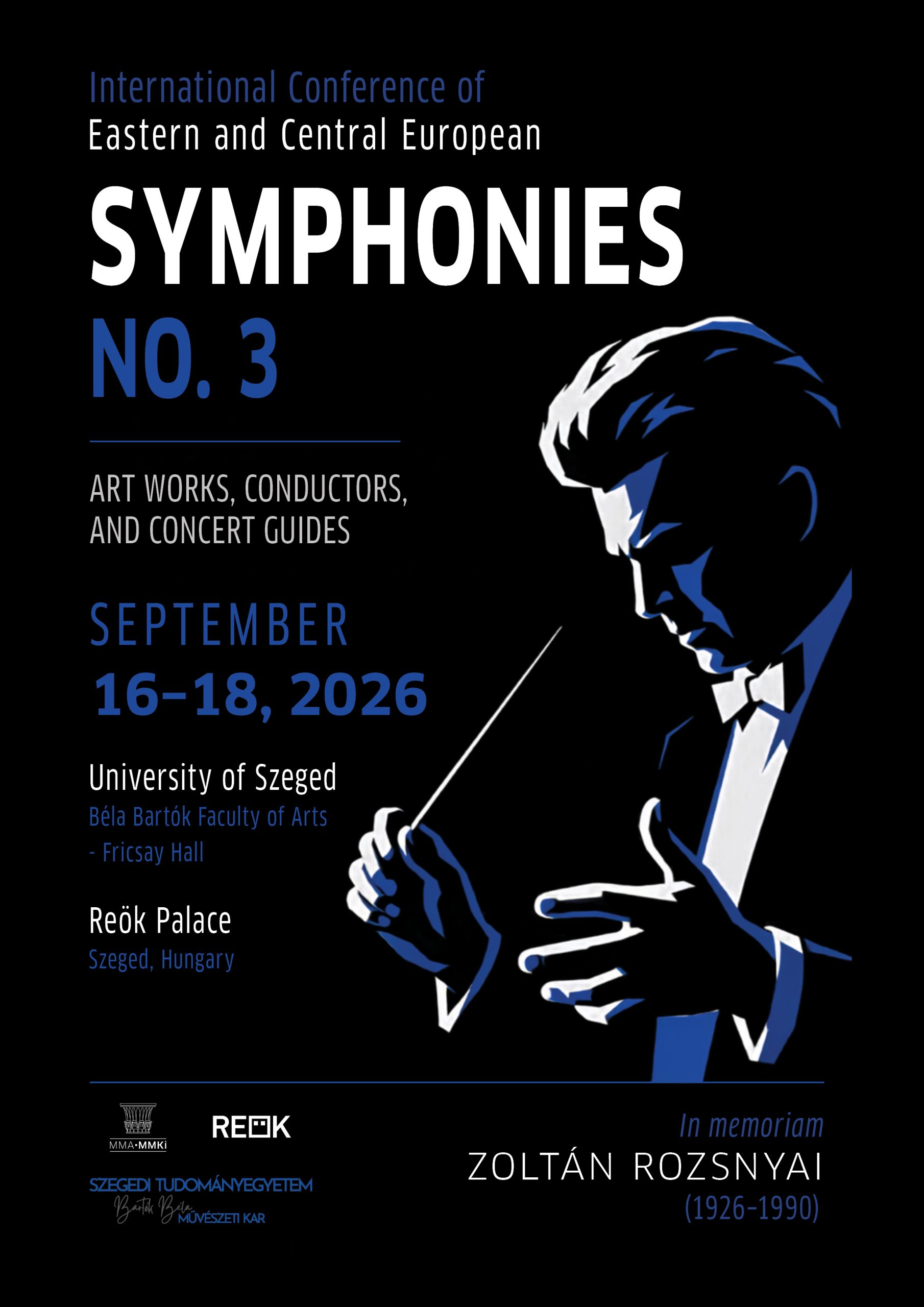
Kapcsolódó személyek


 Újdonság!