


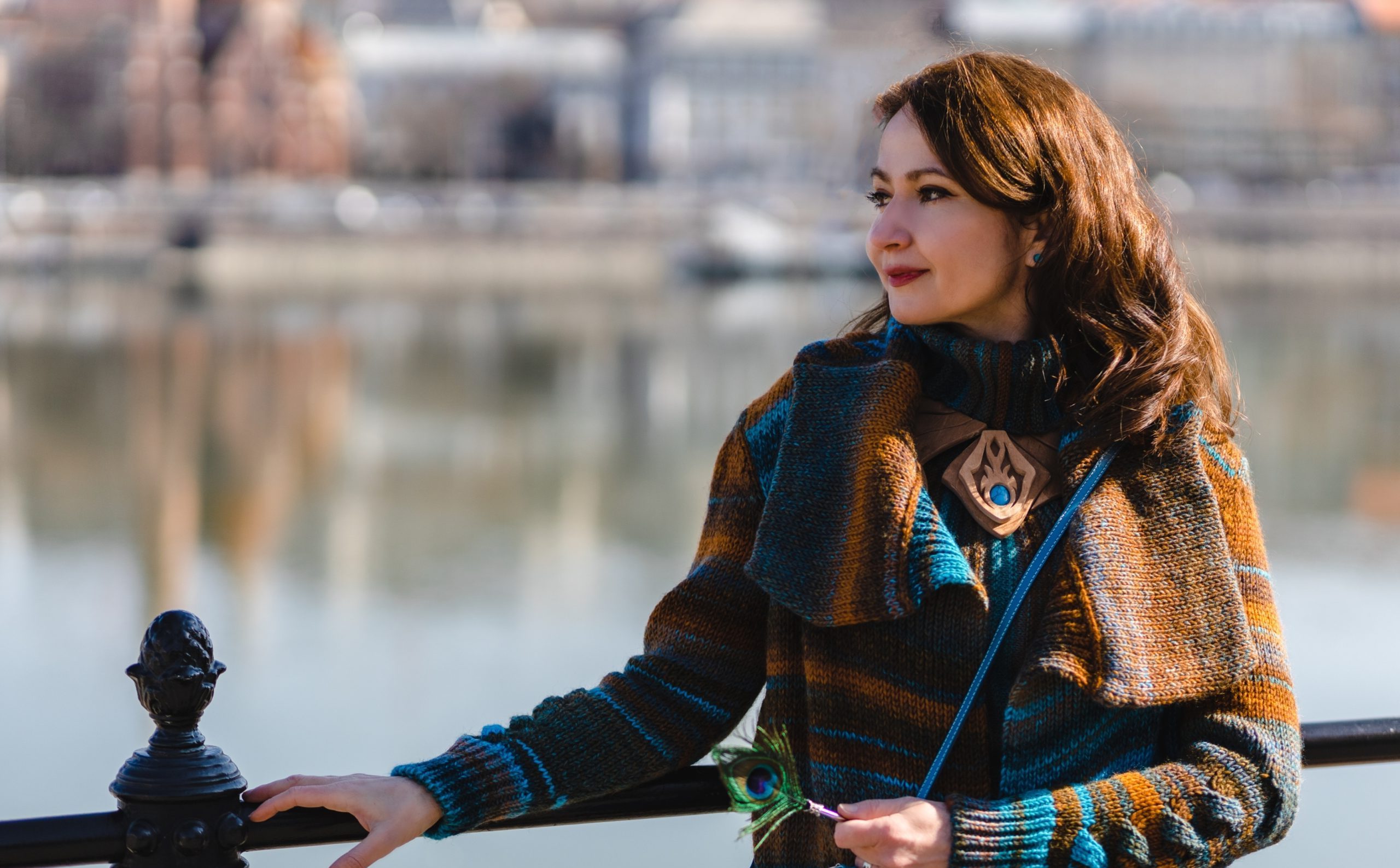
“Art reflects what matters to the community” – interview with Ildikó Tamás
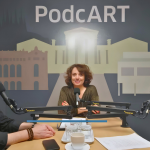
Ildikó Tamás, a linguist, folklore researcher, cultural anthropologist, and literary translator, spoke with textile designer Eszter Söptei, recipient of the Polgár Csaba Prize, and sculptor Réka Gergely in the third episode of PodcART, released in June.
Alongside Gerda Seres, Ildikó Tamás – whose main areas of research include the Sámi language and culture, nonsense in folklore and literature, as well as online folklore and contemporary fashion culture – hosts a video podcast series on arts and culture, launched in May by the Research Institute of Art Theory and Methodology of the Hungarian Academy of Arts and released every two weeks. Ildikó is the editor and presenter of the podcast Divatantropológia (lit. Fashion Anthropology). In our interview, we asked her about the role of art and her personal connection to it.
-If art is truly capable of shaping society, where then does the line between creative freedom and social responsibility lie?
-Art always exists within a social context. For this reason, it’s not independent of the setting in which it’s created. At the same time, however, the creation of an artwork is linked to the individual. Even folkloric phenomena that can be attributed to a community begin with an individual, and only later become part of the community. In the latter case, community norms set the boundaries, but art schools and movements can function in a similar way. They not only rank and categorise works but can also shape the creative process itself. In addition to technique, worldview always plays a significant role, hence why an artwork also has moral dimensions. Perhaps the best way to approach the relationship between creative freedom and social responsibility is to recognise that art is capable of articulating socially relevant themes in such a way as to make an impact. It has a powerful effect on our imagination and emotions, reaching us in ways that other forms of communication can’t. I wouldn’t draw a line between freedom and responsibility. Freedom, though a fundamental necessity, must never be exercised at the expense of others. For this reason, it also carries with it a serious responsibility.
-As a cultural anthropologist, what is your opinion? Is modern man still capable of thinking in terms of shared symbols and narratives, or has our cultural reality become irreversibly fragmented?
-The need for shared narratives will never disappear, since they function as a common language and as overarching interpretative frameworks, and in many cases are the most effective tools for solving problems, coming to terms with trauma, or even encouraging collective thinking. While platforms change, and with them the reach of shared stories, this is perhaps partly the reason why there is occasional talk of a community crisis. I believe that, both historically and socially, individual needs and, at other times, paradigms prioritising the community operate within a fairly broad spectrum. It could be that, at the level of society as a whole, there are fewer shared stories nowadays. We have to navigate a storm of abundant and rapidly changing information, amidst an overwhelming number of narratives. We are all characterised by multiple overlapping identities that come to the fore in different situations, whether global, local, occupational, micro-community-based or countless others. These have always been accompanied by community symbols and stories and this remains true today. This includes folklore as a form of community art, as well as the realm of professional and individual forms of art, which are in constant interaction with each other.
-What is your opinion on the claim that every era produces art that reflects the current state of mind of society?
-Art exists within a social context. It is created by individuals who reflect on their immediate surroundings and events filtered through their inner world. These experiences shape and define the artists’ worldview and form of expression. I believe that art reflects not only what preoccupies a particular person, but also what matters to the community. The artist and their audience together shape the social interpretation. Among other things, we seek answers to questions like these in the episodes of PodcART, drawing on specific examples with the help of artists and scholars.
-In your view, what distinguishes a “genuine” artistic experience from mere consumption in an age where almost everything is presented as content?
-Content consumption is based on quick response times. It primarily informs, caters to immediate needs, and does not seek to hold our attention for long or provoke deep reflection. Art has the power to slow us down, even in this fast-paced world. A work of art has to be contemplated. It invites contemplation and reflection, with aesthetic and intellectual experience working hand in hand.
-Fashion anthropology examines how we express ourselves through the way we dress. Do our clothes still “tell a story” about us today, or do we simply wear roles and expectations?
-Both are true. Beyond the aesthetic message conveyed by clothing, it has always been a means of expressing identity within the spectrum of individual and community needs and expectations. Today, however, performativity is especially strong. We follow a wide variety of patterns and move between online and offline roles, often attempting to project a socially desirable image in the latter. We may be less able to “read” clothing, or perhaps consider it less important than people in earlier time periods did, although this is relative, given that Jókai was already complaining exactly about this even in the mid-19th century. Of course, there is still a wealth of cultural information contained in our outward appearance. As an anthropologist, I’m interested, among other things, in what influences us, how we navigate the maze of trends and algorithms, and to what extent our choices are determined by narratives or aesthetic preferences. This is also interesting from the perspective of what cultural and economic values we ascribe to our clothes, how much we value those who make them, and just how many different questions stem from this, but I could go on at length.
-What do you think is the first thing to be lost in a society when its traditions disappear: its identity, its memory, or its human connections?
-I would say that traditions are constantly evolving, with new ones emerging from time to time (often by reviving old patterns) on a family, local, professional, national and ethnic level. In fact, tradition isn’t the preservation of the past. Rather it forms a bridge between the past and the future. In a constantly changing present, traditions can’t remain static either. Of course, it’s always important first to define what we mean by tradition: the continuity of rites, customs, norms, rules, and forms of behaviour? Identity, memory, and human relationships indeed strongly shape one another, and one of the most obvious expressions of this three-way relationship is to be found in communal rituals and in the narratives that surround them and explain them at the same time. If these undergo significant change, it will undoubtedly go hand in hand with the transformation of the community.
-What’s a cultural phenomenon today that both fascinates and concerns you as an anthropologist?
-I would perhaps highlight the online sphere. It’s fascinating to see the creative ways in which people are able to inhabit new dimensions, create new communities and develop new forms of self-expression in the digital space. In some cases, this also offers a kind of exciting, almost laboratory-like environment for researchers (such as during the lockdown period caused by the COVID-19 pandemic, when we saw how effectively folklore and art were able to play an important role in helping society to process trauma, while adapting to the challenging circumstances). At the same time, it’s worrying to see that our online presence sometimes becomes the defining aspect of life and that identity in this context is increasingly linked to visibility and constant self-presentation. All too often it’s as if we want to document life rather than live it.
-What was the moment or realisation for you personally, when you knew that researching art and culture would become not just a profession, but a lifelong endeavour?
-I wouldn’t be able to pinpoint one specific moment. I think I absorbed this from my immediate surroundings right from childhood, both art and science having played a prominent role in my family. My university years were, of course, particularly formative. That’s where my areas of focus, or at least some of them, took shape, still defining my work today. That is to say, as an anthropologist, folklorist and even as a linguist, I’ve worked in fields related to music, literature and visual arts.
-As a researcher and a host, how do you strike a balance between scholarly objectivity and personal curiosity?
-Anthropology adopts a bottom-up, people-centred perspective and teaches empathy. Critical reflection and an analytical framework are important, but these must be preceded by a deep understanding of the other person or community; finding out what they think, their view on a particular phenomenon, and why they see it the way they do. This understanding encompasses not only information and knowledge, but also emotions and attitudes. As a podcast host, perhaps the most important thing for me is to foster genuine conversations through which the audience can gain a real insight into the world of artists and creators, from their sources of inspiration and techniques to the messages they consider crucial.
-Has there been an encounter or experience that has profoundly changed your way of thinking on a personal level?
-I believe that the succession of encounters and stories we experience constantly shapes us all. By this I don’t mean that we are in a constant flux, shifting from one worldview to another. These transformations occur rarely. However, every new experience makes us more sensitive and helps us to see the world, and its processes, in a more nuanced and complex way. Behind every cultural phenomenon there are real people. It’s always important to keep this in mind, even when summarising these experiences of such encounters in scholarly contexts, filtered through academic categories.
-If you had to convey only one message to PodcART viewers as to why art is essential for the human experience, what would it be?
-Art is one of the most profound ways of understanding the world, forming a bridge between people, communities, values, and eras. It shows us the world and helps us see ourselves through the eyes of others.
Interviewer: Noémi Kecskés
Photo: Kata Futár – Objektív Konyha




 Újdonság!