

“Art is part of our lives; we just need to be receptive to it” – Interview with Gerda Seres
Art not only reflects the processes unfolding around us but can also actively influence and shape them.
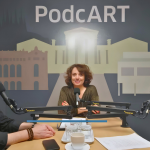
In today’s rapidly changing world, the way artists respond to challenges faced by communities, and the values they convey to the public, have become increasingly significant. This raises an important question: what responsibilities rest on creators, whose works have an impact on public opinion and societal dynamics. How could an artist assist in the development of a more open-minded, empathetic, and balanced society? In search of answers to these questions, the Research Institute of Art Theory and Methodology of the Hungarian Academy of Arts has launched a podcast series on art and culture titled PodcART. The project aims to examine the societal role of art and the underlying connections behind contemporary cultural phenomena with the help of experts and creators.
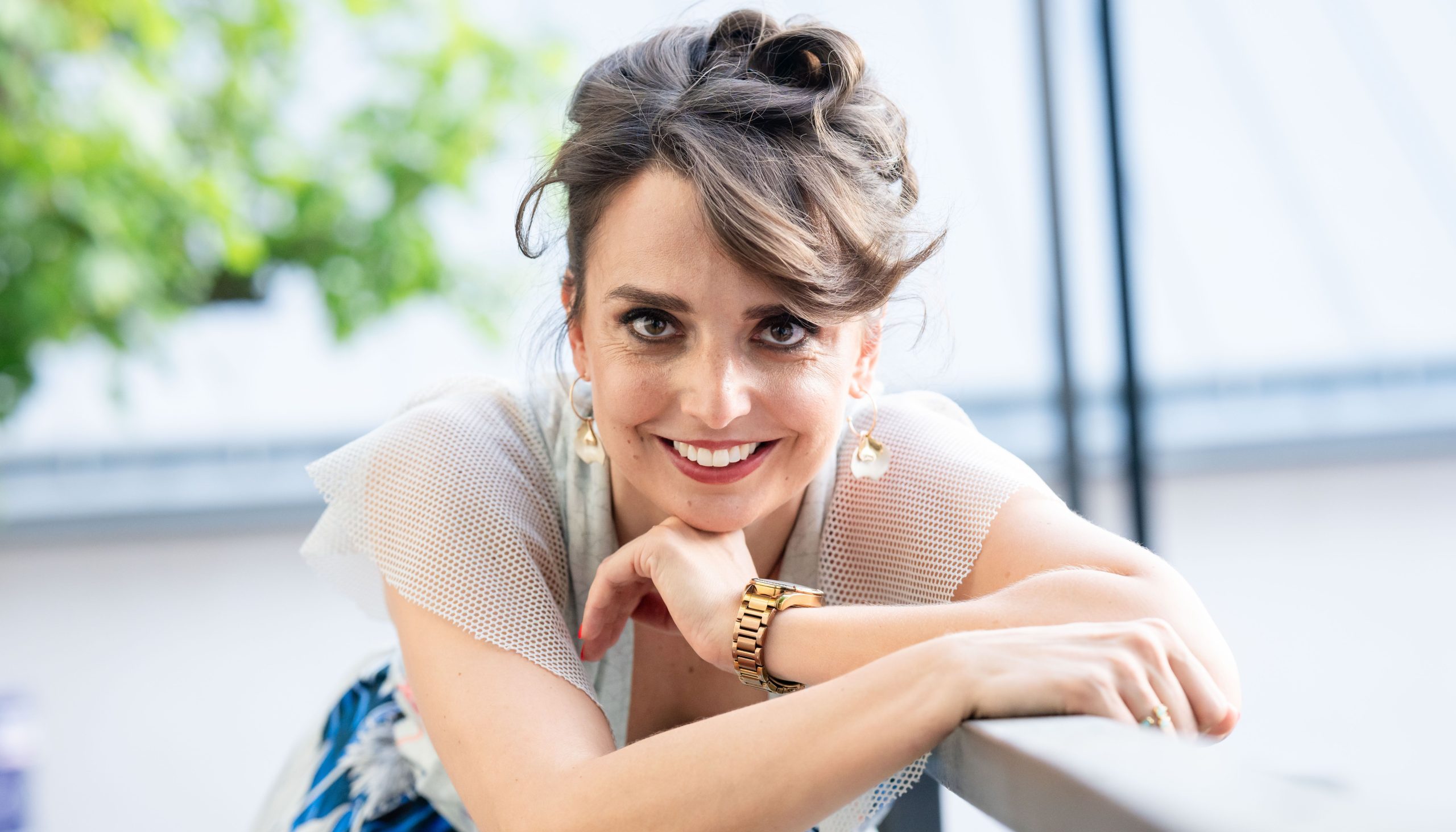
One host of the bi-weekly vodcast series is the Junior Prima Award-winning radio presenter and cultural journalist Gerda Seres, who primarily conducts interviews and leads discussions with well-known figures from the world of art, culture, and theatre. Throughout her career she has published her interviews and reports on numerous cultural platforms, such as Papageno and Kultúra.hu. She is involved in multiple podcast series, including Egyetemes Podcast (lit.Universal Podcast) and Példaképlet (lit. Example Formula). Gerda Seres was a scholarship holder of the Hungarian Academy of Arts Scholarship Programme 2020-2023. During our interview with her, we asked her about her relationship with art.
-A recurring question of PodcART is how art can shape our reality. Do you think it’s more about holding a mirror in front of us, or art serving as a moral compass for us?
-Art, through creating parallel universes, without a doubt shapes our world. An artwork may open doors that, without these visceral experiences, otherwise would stay closed. I’m convinced that art shapes and moulds us. Whether through a moving piece of literature, a work of visual art or a musical composition, our views of the world become more nuanced and, if things go well, raise questions about our worldview. In theatre they say that it’s a successful performance if everyone recognises someone they know in a character. And it’s truly successful when we recognise our own flaws and misconceptions in that mirror. In that sense, art can also serve as a moral compass.
-Which artistic field has the greatest influence on public opinion?
-I wholeheartedly adore theatre and since it can portray conflicts and pit ideas against one another extremely vividly and verbally, I’d probably say theatre. Literature is similar, although it’s a medium where everyone imagines its colours in their own way. I feel like most people need points of reference when it comes to non-verbal genres. A musical piece or a non-figurative painting will have a hundred different interpretations, their effects will be less direct and more widespread.
-As a cultural journalist, you get to meet numerous artists. What do you think: do we still have a common cultural language? Or would you say art is just as fragmented as our society is?
-I believe in discussion and there’s no naivety about that. Twenty-two years of experience in journalism have shown me that there is an incredible strength in open, honest curiosity towards each other. Perhaps we don’t always hear or understand one another properly, but being open-minded is a crucial artistic trait for a creator. Once we have that, we can find a common language.
-For many, the spirit of Villa Hild is a space for deep reflection and discussion. Is there still space for slow, thoughtful cultural dialogue in today’s fast, consumerist media landscape?
-In recent years, whether for an article or a podcast, I kept getting the instruction to keep it short and quick. Supply tries to meet demand, but in my opinion, we shouldn’t make 30-second Reels just because it’s likely that they’ll gain more views than a half an hour long, deep conversation. There is great demand for deep discussions, possibly because it’s what is fading from our everyday interactions due to this frantic lifestyle.
-As a radio journalist, how does the tone and responsibility of a cultural podcast differ from traditional forms of communication?
-The strength of a video podcast lies in the fact that I can hear and see the speaker. It’s easy to tell what they emphasise or when they make a playful comment. This makes for a more direct and powerful effect compared to a written text published online. During my time at Kultúra.hu, I kept advocating including short audio files, fragments of the conversation when publishing interviews to make them more evocative.
-What is the task of an artist today: asking questions or giving answers? Which role is more relevant to you as a journalist?
-I believe in questions. Our answers are our own, what’s important is to think together.
-Launched in May, the goal of PodcART is to present contemporary art and art theory research in an easily accessible way. How difficult is it to find balance between professionalism and a more lighthearted and accessible format?
-Conducting interviews, I had the opportunity to talk to many highly qualified creators more knowledgeable than I am and it always captivates me, whenever someone is able to discuss complex issues in a way that, thanks to their incisive, concise and clear explanation, I can easily understand them too. It’s what I strive for too, although for me it’s not that difficult, since I didn’t come from the academic side of the arts.
-The show focuses on showcasing the members and scholarship holders of the Hungarian Academy of Arts. In your experience what challenges does a Hungarian contemporary artist face today?
-Perhaps the hardest thing today is to demonstrate value amidst all this ’clamour’. Due to the sheer volume of stimuli we’re being bombarded with, the role of artworks that are well-positioned from a marketing perspective is becoming increasingly important. However, many artists are inexperienced in this area, which makes it harder for them to reach their potential audience.
-As an alumna of the Hungarian Academy of Arts’ scholarship programme, how does it feel to return to Villa Hild, which has previously hosted the scholarship meetings, professional discussions and social gatherings?
-I really enjoyed these meetings, because the art theory section brought together an extremely diverse group of people. I was able to gain an insight into topics that later helped me make progress in my own research. Being back now, to me it feels like home.
-What did the scholarship programme offer you? Was it more of a professional opportunity, an intellectual community or a sort of inner reassurance?
-My topic, the socio-critical aspects of Hungarian drama in the 1960s and 70s, stemmed from my personal interest and was relatively far removed from my original profession. Not entirely, because it gave me the opportunity to conduct interviews which, now that a few years have passed, would no longer be possible, as many of the great witnesses to that era have since passed away. I’d like to return to this topic and I’ve been considering expanding on it as part of a doctoral research project for some time, but for the moment I’m tied up with my work.
-Taking turns, you co-host PodcART with cultural anthropologist Ildikó Tamás. How do the journalistic and research perspectives complement each other during the various conversations?
-Ildikó is not only an outstanding researcher but also an experienced interviewer, and it’s this genuine curiosity that makes her a brilliant host. The fact that she knows the field she discusses extremely well can be both an advantage and a challenge for her. After all, she has to step back from the topic a little each time so that listeners who are interested but unfamiliar with the subject can also grasp it.
-Who is Gerda Seres when she’s not behind a microphone, when there are no questions, no storytelling? What’s the environment or activity she truly finds herself in?
-I think Gerda Seres is always asking questions. Even as a child, it was her most distinctive trait, which as an adult, would definitely be annoying if she hadn’t chosen it as her profession. That said, I do enjoy the silence as well. I go hiking a lot, I love the forest, and a lot of different sports can help me unwind. And of course, cultural activities with friends, though it can be hard to tell where the line between work and fun lies.
-Is there a project you’d like to carry out?
-I’d like to launch my own podcast series, and I’m always determined that however old-fashioned I may be, I’ll have a stronger presence on social media. It’s rather difficult for me right now, because I want to focus not on myself, but on the topics and issues I can be a part of through my work.
-If you had to highlight just one idea of PodcART for viewers, what would the message be that the show wants to convey about art and society?
-PodcART is dear to my heart because it aligns with my own views on podcasts: that they create opportunities for in-depth, meaningful conversations, presented in an accessible and entertaining way. If I were to decide on the format myself, I’d be thinking along similar lines. The main message for me is that art isn’t some distant indulgence for the privileged, locked away in an ivory tower, but rather a part of our everyday lives. The building whose doorway we walk through every day on our way home, a well-designed poster, the music coming through the speakers, or a poem posted on Facebook all shape us, even if we never buy a ticket to an art gallery, library or theatre. Art is part of our lives; we just need to be receptive to it.
Interviewer: Noémi Kecskés
Photo: Csaba Schumy



 Újdonság!